The Australian government funded a game designed to scare Sri Lankans from seeking asylum
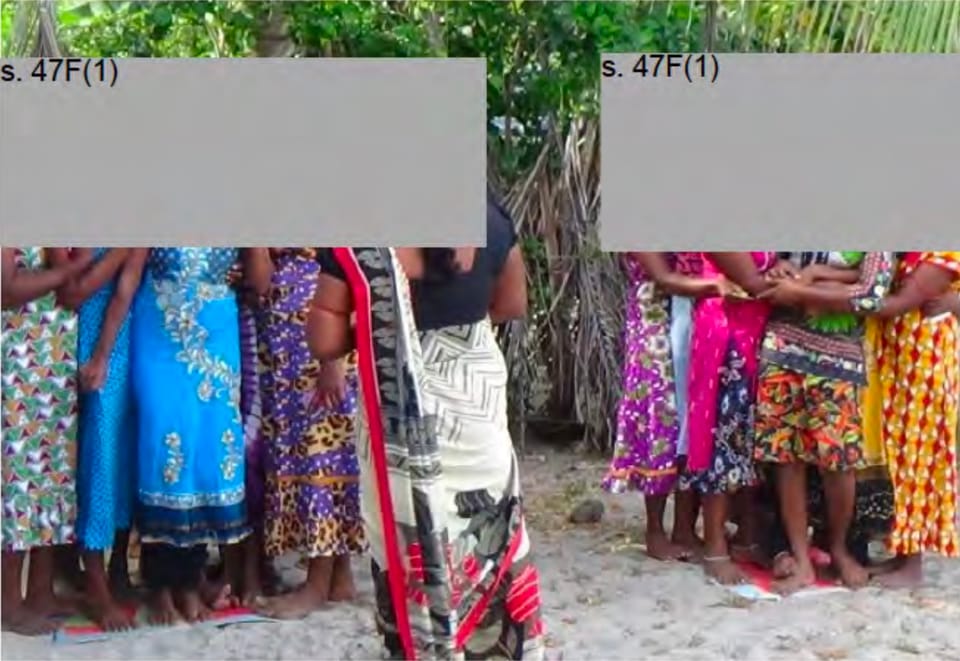
The Australian government funded a monopoly-like game to make Sri Lankans think “their hope and dreams are shattered” if they try to seek asylum in Australia, according to a Freedom of Information release.
The document released contains a set of interim reports from the Association of Mobilizing Community Resources (AMCOR) for their Department of Immigration and Border Protection funded project between 2015 and 2017.
Within that project was the Safe Migration Awareness campaign designed to discourage Sri Lankans from fleeing to Australia with “The Boat Game".
“We designed this game with real life scenarios like the monopoly game...designed in a manner where they fail entering into the land of opportunities, where their aspirations become just another dream,” the report said.
Ten participants are “squashed in a small boat” and assigned a number not unlike the Boat IDs issued to asylum seekers upon arrival in Australia.
The game then progresses with spins of a wheel containing various scenarios aimed to eliminate participants from the game.
“One member could be arrested by the coast guard.
“Someone else could be sick and thrown out in the ocean.”
When two participants remain, only one person can reach Australia and the other is arrested.
“Participating in this game members realize [sic] that the risk they take is immense and most likely their life could be in misery.”
Former immigration department staffer Frederika Steen says this isn’t the first time the government has funded campaigns to deter asylum seekers from making the journey here.
In March 2000 when Steen was working in the Australian embassy in Berlin as the Chief Migration Officer, then minister Phillip Ruddock was on a tour to market a project to deter people from coming to Australia.
“It was posters and a booklet, and he actually took that with him to Berlin. On the front page of the little booklet about Australia’s repelling policies was a picture with fences and barbed wires."
A Freedom of Information release obtained by Buzzfeed in 2019 revealed printed advertising material for a campaign created by the Department of Home Affairs “designed to dissuade people smuggling” and included a poster of fake horoscopes that was distributed in Sri Lanka.
Community worker and registered migration agent Rebecca Lim says Sri Lankans are particularly targeted by the Australian Government who implemented the enhanced screening process in October 2012 designed for unauthorised boat arrivals from Sri Lanka.
“You come in a boat, the Australian Navy doesn’t even have to disembark you, they can just interview you by phone on the boat.”
Lim, who worked with people detained on Manus Island in Papua New Guinea, says many of the Tamils who ended up there told her that if they didn’t agree to go to Manus they would have been screened out.
According to the Australian Human Rights Centre, 965 people were returned to Sri Lanka under this process between October 2012 and May 2013.
The Department of Foreign Affairs and Trade (DFAT) prepares Country Information Reports for the purposes of assessing protection claims, but Lim says they're unreliable.
“The DFAT reports can’t be objective as it is an agency of the Australian government and relying on these reports sets up the claimants from Sri Lanka to fail,” says Lim.
In October 2020, a joint letter from the International Truth and Justice Project (ITJP) and the Australian Centre for International Justice (ACIJ) was sent to DFAT urging them to set aside their Country Information Report on Sri Lanka on the basis that it is factually incorrect and downplays the torture risk faced by Tamils.
In May this year, the United Kingdom’s Upper Tribunal found that the sources informing DFAT's judgement and assessment in the Sri Lanka report were unclear and the reliability of its conclusions is difficult to gauge.
“None of the sources are identified, there is no explanation as to how the information from these sources was obtained, and there is no annex containing, for example, records of any interviews.
"Indeed, it is unclear whether any formal interviews took place."
Member discussion