How the arms industry is shaping the Australian education system
“The deeper I go, the more I can see how our curriculum and funding for schools is based on building a workforce for weapons manufacturing,” says Queensland school teacher Hannah*.
Schools have been known throughout history to socialise young people into supporting power structures and churn out obedient citizens.
“The educational system is supposed to train people to be obedient, conformist, not think too much, do what you’re told, stay passive, don’t cause any crises of democracy, don’t raise any questions,” says American linguist Noam Chomsky.
As Australia pushes to become a top 10 global defence exporter, private defence contractors and the defence department are embedding themselves within all levels of the Australian education system, cultivating a positive image with the aim to secure a future workforce.
These are the same companies providing Israel with an arsenal of weaponry amidst their ongoing bombardment of occupied Palestine which has killed at least 37,000 people since 7 October 2023.
It’s those companies’ weapons being used to commit scholasticide in Gaza, where more than 80% of schools have been destroyed, 5,479 students, 261 teachers and 95 university professors have been killed, and not a single university remains.
The latest published data from the Department of Foreign Affairs and Trade ‘country and commodity pivot tables’ shows Australia has exported over $1.5 million of ‘arms and ammunition’ to Israel in February 2024 alone.
On top of that, the federal government has unveiled plans to drastically increase defence spending to $764.6 billion over the next decade.
An article published in the New York Times describes Australia’s increasing weapons manufacturing capabilities as a push to become the United States’ “51st state for defense production”, with the biggest players in Australia’s growing weapons industry, including Lockheed Martin, Boeing, Northrop Grumman and RTX (formerly Raytheon), all being US-owned.
These hefty investments in Australia’s defence industry have created a demand for a larger workforce, and the landscape of Australia’s education system is shifting as a result.
Exposure to the weapons industry starts early, with the government outlining its intention to target children in its efforts to secure a workforce within defence industries.
The Australian Department of Defence’s 2019 to 2030 workforce strategic vision aims to influence children into pursuing STEM careers in defence by shaping the national school curriculum, sponsoring high-profile STEM competitions, creating products for teaching, and promoting “success stories” via media platforms.
The strategy addresses a cohesive “One Defence approach” that intersects across government, industry and academia, with a vision “supported by a set of key objectives that will allow Defence to take a leading role in shaping the science, technology, engineering and mathematics eco-system”.
“It’s 2030,” the document envisions.
“Significantly more primary school students have identified STEM for their future career paths, large numbers of Indigenous students are now enrolling in STEM courses, high school students have moved into STEM careers and university students are now working in the STEM sector.
“Teachers have also helped promote these career opportunities as they are resourced with curriculum relevant STEM materials, showcasing theoretical science in real world applications across Defence and more broadly.
“Defence is seen as an employer of choice for STEM graduates.”
This strategic vision is being realised and it can be seen playing out in Australian schools.
While Queensland’s Department of Education has deemed school sponsorships from organisations involving “the manufacturing or selling of weapons including guns, or would be associated with the use of weapons” unacceptable, weapons manufacturers are still directly involved with Queensland schools.
The Department of Employment, Small Business and Training’s Gateway to Industry Schools program (GISP) connects schools with industry partners across 12 sectors and students participate in projects and activities led by GISP partners.
The Aerospace GISP was established by the Queensland Government in 2004 and is supported by the Royal Australian Air Force and big players in weapons manufacturing including Boeing, Northrop Grumman, RTX and TAE Aerospace.
There are currently 29 schools participating in the program, facilitating direct interactions between children and employees of industry partners through holiday workshops, classroom visits and career days, ultimately designed to develop an “effective workforce” for the aerospace industry.
Aerospace GISP also hosts industry education awards, teacher training opportunities and conferences, and overseas trips funded by their industry partners.
In July 2024, four Queensland students and three teachers will travel to the United States to participate in Space Camp at the US Space and Rocket Center in Huntsville, Alabama, with the trip fully funded by weapons manufacturer Northrop Grumman.
The Australian Defence Magazine reported in 2017 that the annual trips to space camp established by Aerospace GISP included a tour of the Boeing plant.
The Advanced Manufacturing GISP is similar, offering “a range of experiences” to “develop best practice models of pipelining talent to advanced manufacturing industries”, including the aerospace and defence industries.
Industry partners of the program include Ferra Engineering and G&O Kert, companies with key roles in the production of Lockheed Martin F-35 Lightning II fighter jets that are known to be used in the bombardment of Palestine.
50 schools participate in the program with almost 4000 students, and 88 per cent of those students are said to be considering a career in advanced manufacturing.
Bringing the influence into classrooms more directly, the Future U program, designed by Boeing and Discovery Education, is partnered with the University of South Australia and Regional Development Australia (RDA) to embed lesson plans they have designed into the national school curriculum.
The program was piloted at two schools in Queensland and New South Wales in 2021, aimed at “enabling teachers of years 7-10 students to engage, educate and inspire young minds on a diverse range of space career pathways”.
“By tailoring our content into the national curriculum we’re hoping to expose students early to key skills and knowledge that capture the hearts and minds of future space leaders and innovators and grow our talent pipeline,” says Boeing’s senior manager for University Relations and STEM Sandra James.
“Future U is an ideal vehicle to attract talent to Australia’s Department of Defence, Defence Industries and to build our space sovereignty,” Rick Evans, RDA Hunter’s then STEM workforce manager, said in 2021.
Children are further targeted through extracurricular STEM programs and competitions.
The National Youth Science Forum (NYSF), a not-for-profit “run by youth, for youth”, names Lockheed Martin as the major partner of their program.
“Our strong relationship with Lockheed Martin Australia helps students connect with a myriad of training and work opportunities they might otherwise not know exist,” chair of the NYSF board Kerri Hartland said in 2022 regarding the renewed partnership with the weapons manufacturer.
NYSF is also partnered with the Australian government’s Defence Science Technology Group.
International not-for-profit organisation FIRST designs STEM programs for schools and after-school activities, including the FIRST Lego League program for children aged four to 16.
Sponsorship and partnership information is no longer available on the FIRST website, however, an archived version of the website from January 2024 shows strong relationships with weapons manufacturers BAE Systems and Boeing.
“Students who have gone through the FIRST programs are often recruited for internships and full-time positions by the supporters of FIRST,” the organisation says.
The Medical Association for the Prevention of War presents a non-exhaustive list of a further 30 Australian STEM programs with sponsorships or partnerships with weapons companies in their report ‘Minors and Missiles: Weapons Companies in Schools 2022’.
Queensland secondary school teacher Hannah says she was shocked to discover the extent of involvement of private weapons manufacturers in education at both the primary and secondary school level.
“I don't believe that parents and students and teachers are well aware of who’s funding these programs."
In April, six motions were put forward to the Queensland Teachers’ Union (QTU) Executive, calling on Education Queensland to address concerns about the involvement of weapons manufacturers in schools.
These included a call for the Department to review and disclose all relationships and partnerships between themselves and weapons manufacturers, provide funding for alternative STEM programs that create critical solutions for human survival rather than weapons, and protect QTU members who refuse to promote or participate in those programs.
All six motions passed successfully through a number of branches and the State Council and are now with the QTU Executive.
“Teachers, particularly, and students, schools, and the whole Australian public, I think, have been dragged into this investment in war…that I don't feel that we've consented to,” Hannah says.
“I think a lot of us want to oppose this investment of our kids’ education.”
The targeted recruitment of young people into weapons manufacturing becomes more overt in tertiary educational institutions and since October 2023, universities have been under increased scrutiny for their corporate and military relationships with direct links to the state of Israel and its ongoing assault on occupied Palestine.
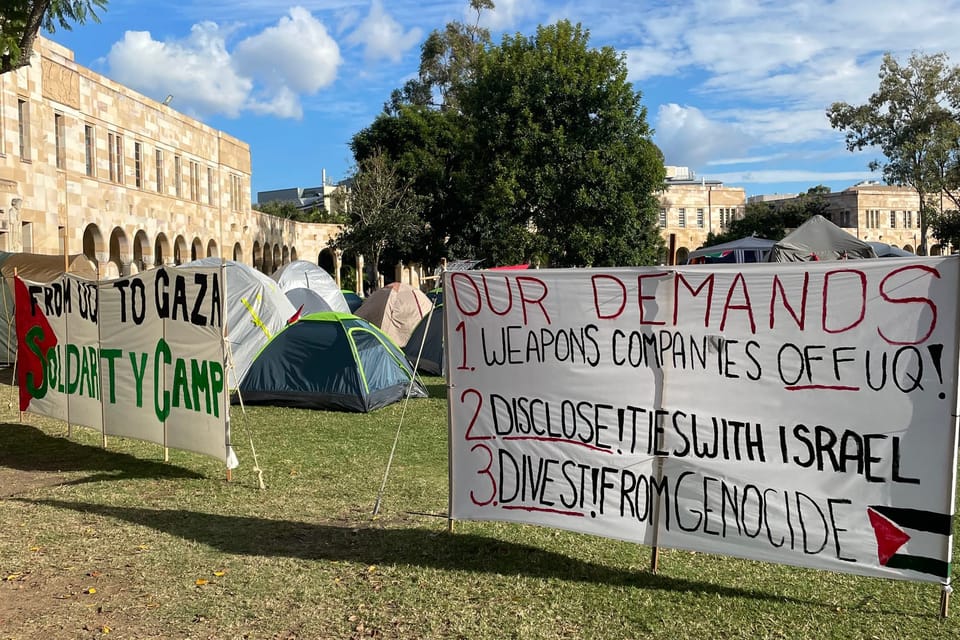
Protest encampments emerged at university campuses across the United States in April 2024 and ignited a global student anti-genocide movement, drawing attention to these relationships and demanding their universities disclose, divest from and cut ties with Israel and the weapons industry.
Social anthropology researcher Dr Elise Imray Papineau says that through her role as an educator and researcher, she has found rather troubling dynamics when it comes to universities’ relationships with the corporations that fund them.
“A lot the big funding bodies that support universities are themselves businesses and are sometimes quite corrupt in themselves, so you see a lot influence from companies that then have an impact on the way that certain students will be funnelled into pathways for employment.
“Rather than these being spaces for progressive thinking, for fostering critical thought and openness, a lot of methods around teaching and learning are shaped by businesses, by corporations and by interests that are often quite unethical.”
The corporatisation of universities also means that research opportunities would be limited if they aren’t pandering to the expectations and interests of the businesses their funding is coming from, Dr Imray Papineau says.
“There’s definitely a neoliberal model that underscores universities and other spaces of teaching and learning. That’s actually a quite stark contrast to what these spaces are meant to be.
“I think that has real serious implications for the future of pedagogical spaces as well as the future of research overall.”
The University of Queensland (UQ) has had a long-running partnership with Boeing since 2003, and since 2017 has hosted the company’s own research centre within the university’s St Lucia campus.
The Boeing Research and Technology Australia Centre (BRTAC) is the first university-based Boeing research and development facility to be embedded into a university campus in the Asia-Pacific region, where Boeing staff work with UQ researchers and students in a range of fields.
"We will enhance our access to UQ’s world-class researchers in engineering, human movement, neuroscience, chemistry, physics and psychology, as well as investigators in software and hardware components,” Boeing Research & Technology Australia Manager Dr Jason Armstrong said in 2017.
“We hope that by being located in a high-traffic area on campus, we will attract interest from students who may then work in our industry and/or undertake high-level study in the fields of aerospace.”
Projects and studies conducted at the centre include “unmanned aircraft and autonomous systems, aircraft simulator technologies, manufacturing technologies, and cabin disease transmission”.
UQ Adjunct Professor of Engineering David Hood AM says he is concerned about the influence on students by Boeing and other weapons manufacturers partnered with the university.
“There’d be a lot of propaganda, subtle propaganda, driven through the involvement of Boeing in the faculty. It’s very hard for a company funding research at a university to avoid its self interest in what it really wants, and what Boeing wants is profit…which means that the outcomes of the research would be used for anything that they do to increase profit.
“The concern now is very visible with the war in Gaza, and we should be even more vigilant in terms of what we’re doing with students. I just get a feeling that the students would see the Boeing involvement as an enticement for them to not worry so much about war.”
Professor Hood, formerly the National President of the industry body Engineers Australia, assisted in the development of their code of ethics and accredited a number of engineering courses through the body.
“I have seen a gradual creep of the government withdrawing funding from the universities and telling them to go and get money from industry.
“It’s been driven by the sort of neoliberal right-wing idea that…the universities should be thinking of getting money from industry and doing what industry wants, the research that industry wants, and that’s been pervasive right up until now.
“It’s very hard to accept millions of dollars in research funding without doing what the company wants with that money. It’s capture. They capture the universities.”
Third year mechatronic engineering student at UQ, James*, says he has noticed an influence from the defence industry on his degree, particularly as engineering honours degrees require students to complete a supervised thesis.
“Lots of the supervisors I’ve spoken to, their background is in defence, and a lot of the lecturers, as teachers and leaders of the course, have backgrounds in defence.
“One lecturer I wanted to do my thesis with did her PhD in an area I was interested in, but then in another conversation she mentioned her background was in defence.
“Another lecturer invited me to their lab to discuss my thesis, but I hadn’t realised their whole field is drones. They were just building heaps of drones and they ‘couldn’t disclose what they were being used for’, but there was a lot of Department of Defence branding around.”
James says there is also a culture of support for weapons and defence industries among the engineering student cohort at UQ.
“I thought for ages, before there was the [Palestinian solidarity] encampment at uni, I thought it was just apathy. But it’s not actually apathy – I think it’s support.
“People in the engineering building are aware of the university’s links to these companies, but they see them as necessary or important. And [these students] are also definitely career driven, and there’s like a prestige around those types of companies.”
James says progressing through his degree and starting a career in his field is difficult because he wants to avoid contributing to harmful industries.
“I started this degree because I thought it was really interesting and was keen to see what kind of applications there were for this learning, but as I approach the end of my course I am quite fearful that there aren’t options for my career beyond mining and weapons.
“That industry at large is so interwoven with these companies that even being outspoken in disagreement feels like career suicide. So many industries have fingers in the pie of weapons and defence that sometimes it feels like it is the only work that is being done.”
Boeing Australia was contacted for comment and did not respond.
Professor Hood says universities need to focus on sustainability rather than weapons, with climate change being the biggest threat to Australia’s security.
“When it hits very soon, we’re going to see more serious and intense storms more frequently. We’re going to see cyclones. We’re going to see flooding rains, because warmer atmosphere holds more moisture, and floods are going to increase. The temperature is going to increase and people are going to die…This is the threat that’s coming.”
“The universities should spend far more research into the future of the planet and what’s happening with climate change and sustainability more generally.
“Engineers learn nothing about nature in their education, and they wind up as practicing engineers not concerned so much about what their projects are doing to nature. So if nature is in the way of the project, [they] get rid of it.”
University partnerships with defence industries outside of STEM fields are lesser known.
UQ’s Humanities, Arts and Social Sciences department has collaborated extensively on projects with the Australian Department of Defence and its stakeholders through its ‘WhatIF Lab’.
The WhatIF Lab employs a “story thinking” methodology which engages and adapts the imaginations and skills of a global network of authors and scholars with expertise in speculative and science fiction writing to workshop and problem-solve potential future scenarios.
In 2022, the WhatIF Lab launched ‘The Ursula Project’ in collaboration with the Australian Department of Defence, Science and Technology to utilise the four domains of speculative fiction writing – setting, character, plot, and style – for technology foresight research.
“In effect, the methodology provides a 360-degree way of thinking about future problems, addressing the need for determining how technologies and tactics may converge in future military and security scenarios,” the WhatIF Lab says.
UQ also collaborates with the United States’ Defense Advanced Research Projects Agency (DARPA), army, air force, navy, and space agency, and holds private defence partnerships with companies including BAE Systems, Lockheed Martin, and Thales.
This widespread involvement of defence companies across Australia’s education system has demonstrated a clear aim to entice young people into joining a workforce that profits off war.
While Palestinian children are bombed in tents by Lockheed Martin’s F-35 jets, Australian schools are pushing their students into, one day, building them.
* Names have been changed.
Member discussion