Refugees in Indonesia still stranded as fall of Kabul intensifies crisis
This story was originally produced for radio and aired on 4ZZZ on 22 March 2022.
Content warning: the following story includes accounts of violence, suicide and other content readers may find distressing.
“I was alone when I came to Indonesia, when I left my homeland.”
Abdul was 16 years-old when he fled Afghanistan in 2014, and he’s one of about 14,000 refugees stranded in Indonesia for almost a decade. About half of them are from Afghanistan, many who, like Abdul, were forced to escape out of fear of ethnic persecution from the Taliban for being Hazara, a minority group that have historically been targets of violence and persecution since at least the late 19th century.
Abdul escaped to Indonesia, but instead of finding safety, he was detained for almost four years in an immigration detention centre (IDC).
“42 months and like 16 or 17 days,” he says precisely.
“It's just by the name of ‘detention centre’. It's exactly like prison. Even the building is like a prison, everything is like prison. Everything is limited in there.
“I was 16 years old when I entered the ‘IDC’, or the prison…and it's like, we cannot see the sky. It's a real prison. No education in there, nothing to do in there. Just wait and pray to the God.”
Jamil, also Hazara, was 23 when he was forced to flee Afghanistan after finding out the Taliban were looking for him, leaving behind his wife and two young children. He was a computer science student at Kabul Polytechnic University and taught basic computer programs.
“The Taliban had been looking for me because, according to the Taliban rule, it was a major sin to have a computer and English skills. When I saw my life was in danger in Afghanistan, I decided to immediately leave the country because I was very, very afraid.”
When he arrived in Indonesia by boat in November 2014, Jamil had no way to support himself, and he registered as a refugee at the UNHCR office. In December, he moved to Pekanbaru City, the capital city of Indonesia’s Riau Province, and went to an immigration centre to ask for assistance.
“After living at the side of the road in front of the immigration centre for about one week, I was transferred to a temporary hotel in the city.”
Over a year later, he was moved to an immigration detention centre where he’d be imprisoned for over two and a half years.
Australia has faced continued criticism internationally for its offshore processing policies on Manus Island and Nauru where damning reports of human rights abuses have been extensively documented, but few have heard about Australia's migration control operations elsewhere.
Asher Hirsch, Senior Policy Officer at the Refugee Council of Australia, says since 2001 and even before then, Australia has been conducting a number of operations to try to stop asylum seekers from reaching Australian territory and applying for protection.
“A lot of people in Australia know about our offshore processing policies in Nauru and PNG, but what people don't know is that Australia’s also been conducting other operations in Indonesia, Sri Lanka, Malaysia, and throughout Southeast Asia to try and keep people stranded in those countries and prevent them from leaving.
“That involves funding other countries to increase their police surveillance and policing operations to stop boats leaving, and also funding detention centres throughout the area, and especially in Indonesia, and a range of other programs [and advertising campaigns] designed to dissuade people and…try and stop them from coming to Australia.”
(I wrote about another one of these programs last year. You can read about it here.)
The International Organisation for Migration (IOM) is an international organisation that, while a separate entity from the United Nations, works alongside it on migration matters.
“The way that IOM works is that it often takes projects that are funded by different states to do certain types of [things] to manage migration, as it calls it,” Hirsch explains.
“In Indonesia, a lot of the funding that IOM has comes from Australia and has been part of that deterrence policy since 2001.
“Australia and Indonesia and the IOM formed a regional cooperation arrangement, basically, that the Indonesian government, especially the police and immigration officials, would intercept and detain refugees in Indonesia, just stop them coming to Australia. Australia would fund and support those policing operations.”
Australia also funds IOM to support Indonesia with immigration detention, he says, to provide food, shelter and some basic medical needs to detainees so they wouldn’t come to Australia and would remain in Indonesia.
Hirsch says this developed over time, and in 2017-18, IOM were successful in pushing to get most people released from detention.
“Most of what IOM still continues to do is run and facilitate community housing centres, which are better than detention but still keep refugees stranded in limbo and they have quite strict restriction on their movement and activities in Indonesia as well.
“So in some ways, IOM is operating in a way that benefits Australia…so that's serving Australia's ultimate deterrence goals.”
But Jamil says that most refugees in Indonesia don’t actually have places to live.
“Some of them are under the register of the IOM. Most of them are paying the rent of their house and their food and everything by themselves,” he says.
After he was released from detention, Abdul moved into one of IOM’s houses, but he tells me they still lack access to basic rights.
“We are deprived from education…we don't have permission to work, we don't have permission to [move] from this city to another city, and we are not even allowed to be outside of our accommodation houses for [all] 24 hours. We are free here from six o'clock in the morning until 10 o'clock in the night.
“Refugees are suffering because they are losing their hopes, and their times are wasted here and they are spending their time without any answers to anything, and waiting for resettlement.”
The fall of Kabul
When I first spoke with Jamil and Abdul, it was about eight months after the United States military quietly pulled out of Afghanistan and the Taliban rapidly seized control of the territory.
“Everything is completely changed, and especially for the Hazara people,” Jamil says.
Before this, Jamil could sometimes contact his family back home, but he hasn’t been able to speak with them at all for the past eight months.
“My family does not have access to the internet, so I cannot contact them. It's a long time that I didn't talk with my mother, with my family, with my wife and my kids.
“Not only me. Most of the people that are living here, actually, most of them cannot access their families, because [over] there it’s a village. There is not an antenna, and no telecommunication, and they cannot contact their families.
“It is very hard for a father that, for a long time, you can’t see your parents, your siblings, your wife, your children. So many refugees like me, we are living like this.”
Abdul hasn’t been able to contact his family in Afghanistan much either.
“I'm really worried about them because sometimes I can contact them, but sometimes I cannot. In the last four months, I contacted them maybe twice or three times…due to not having internet, there is no signal. I cannot contact frequently. And so many like me even lose their connection with their family after the Taliban came in power.”
This, he says, is the reason there have been so many suicide attempts among refugees in Indonesia in the last two months.
“We have an old man here and he is about 55 years-old. He tried to kill himself two days ago.
“We have a lot of people like him…especially Afghan Hazara refugees here. When I am talking to them and ask, ‘have you ever thought about doing suicide, do you ever think about killing yourself?’
“There is so much attempt to commit suicide, like…some people set themselves on fire and some people harm.
“Of course, I'm sure some people, they think about committing suicide, twice or three times in a month because of this life and because of uncertain life in Indonesia, and we totally lose our hope.”
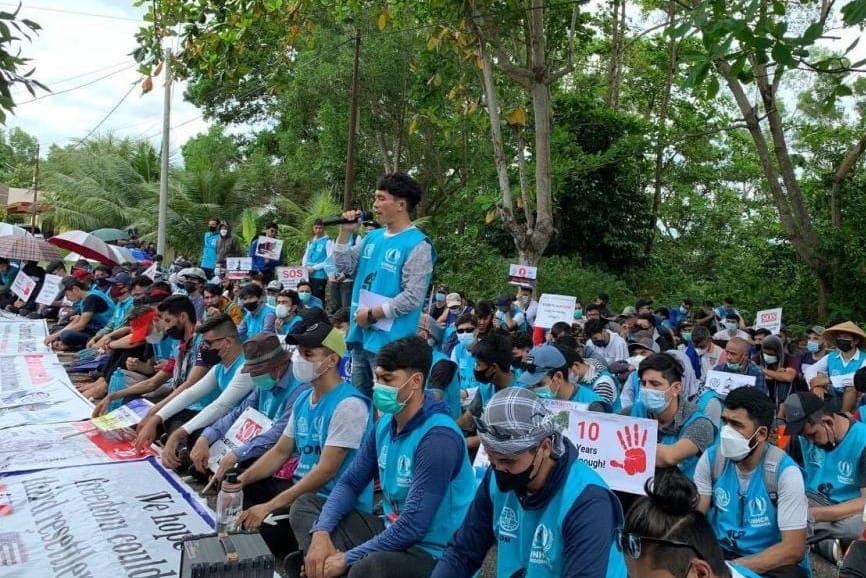
Both men tell me about demonstrations that have been organised by refugees around Indonesia over the last six months to protest their conditions to the United Nations High Commissioner for Refugees (UNHCR). When I ask if it’s dangerous to protest, they both say yes.
Jamil says the police beat them.
“The behaviour [of] Indonesian police or Indonesian authorities… they beat the refugees, and they want to keep the refugees silent, that they should not raise their voices to be heard. It is very, very, very sad and difficult for us,” he says.
People haven’t received any response to their protests and things continue to be as up in the air as always. UNHCR tells them it’s out of their hands and that they can’t do anything until a third country accepts them.
Hirsch says UNHCR in Indonesia is very limited in its capacity to help refugees on the ground there, and their primary role is to assess asylum claims and determine if people are indeed refugees according to the Refugee Convention. They then facilitate third country resettlement by finding places around the world.
“UNHCR tries to do more in Indonesia and throughout the whole world, but they are very restricted by their ability to find resettlement because it's up to the states like Australia, the US and Canada, and others who actually offer resettlement places and accept people. UNHCR can only facilitate that resettlement process; they don't actually have any role in actually providing that resettlement because that's the role of states around the world.
“The problem is that only a few hundred places are found for refugees in Indonesia every year, which means that most of the 14,000 people who are stranded there are not going to get resettlement, or at least not for the next 10 years or more."
The number of available resettlement places around the world was significantly reduced after Australia introduced policy that anybody who registered as a refugee with UNHCR after July 2014 would not be resettled in Australia. Then the Trump administration’s decimation of the US’s refugee program, which is only now starting to open back up again, and the significant impacts of Covid-19 on international travel have further reduced available places.
But Hirsch says there are a number of things Australia could do to alleviate the crisis and ease people’s desperation.
“One, we should reinstate resettlement programs from Indonesia and be taking a number of people every year from there, and in fact, increasing it to address the ongoing situation as well as finding resettlement solutions elsewhere. America and Canada both also announced quite a large Afghan resettlement program, and we hope that some refugees in Indonesia will be able to use that program.”
Australia’s Afghan resettlement program, however, probably won’t be an option for refugees in Indonesia because it’s hardly a resettlement program at all.
“It's 10,000 humanitarian places and 5,000 family reunion places, but the thing with that announcement is that it's only within the existing quotas, within the existing humanitarian program and within the existing family program, so it actually doesn't create any additional visas. And it's over four years, so it's quite a very small announcement."
Of those 10,000 humanitarian places, about half of those will go to Afghan refugees who are already in Australia after being evacuated following the fall of Kabul. That leaves about 5,000, and Hirsch says it's not clear what Australia's policy is in terms of prioritising those 5,000.
“There are about 150,000 people who have applied to come to Australia in the humanitarian program and they have to select 5,000, so you can see the demand way outstrips the number of visas available to people.”
Hirsch also thinks Australia has a better diplomatic role to play throughout the Asia Pacific, especially in Indonesia, in trying to work with host countries to try to improve their conditions.
“So if Australia and New Zealand say to Indonesia, we’ll take 500 refugees each year if you give those who remain work rights and basic rights just to stay temporarily, I think that would help ease a lot of the situation.
“I think, definitely, Australia should be thinking about resettling people from Indonesia who are from Afghanistan, but even if they do so, it's not going to really make much of a dent to the population there.
“For most people in Indonesia, resettlement’s going to be a very, very long wait, if at all."
Update: In the years since I first spoke with Abdul and Jamil, both have been safely resettled in North America. However, as of 15 May 2025, over 13,000 refugees still remain in Indonesia.
Member discussion