The Liberal PM who wanted to close Pine Gap
Fraser's focus in Dangerous Allies was Australia’s ‘strategic dependence’ on foreign powers like the United States: “For the entirety of our history, Australia has been reliant on ‘great and powerful friends’ for our sense of national security and for direction on our foreign policy priorities.”[1]
He wrote that Australia has “become more closely bound” to the United States than it ever was during the Cold War. This transpired through “the closeness of our armed forces, the pursuit of interoperability and communications and weapons technology”.
“The changes have come about without reference to the Australian people,” he said. “It has occurred virtually by stealth.”[2]
The “rise of neo-conservatism and the growing influence of American exceptionalism have changed America” both as a nation and an ally to Australia, says Fraser.
“In this context, Australia needs to consider whether its position is best suited by continuing its policy of strategic dependence, particularly given that the United States shoulders much, not all, but much of the blame for how the new international order the world hoped for in 1990 has been derailed.”
In 2013, a Fairfax Media investigation revealed that a primary function of Pine Gap, the joint US-Australia satellite intelligence base in the Northern Territory, is to “track the precise 'geolocation' of radio signals, including hand-held radios and mobile phones, in the eastern hemisphere, from the Middle East across Asia to China, North Korea and the Russian far east”.[3] This information “then feeds into the United States drone strike program and other military operations”.[4]
Fraser wrote of “the moral dilemma in which we find ourselves on account of our intelligence sharing arrangements with the United States”.
“The idea that we are spying for, and on behalf of, the United States, that we in fact are their agent, that we use our embassies in neighbouring countries, is not helpful to establishing good relations… This will be just one more factor that tends to make America’s enemies our enemies.”
The “extraordinary” development of Pine Gap’s capabilities has created “the technical basis” for the facility to “provide data enabling the targeting of illegal US drone attacks”, said Fraser.
“Significant numbers of civilians have been killed as a result of drone attacks in countries with whom neither the United States nor [Australia] are at war. These civilian deaths raise serious questions of the possible perpetration of war crimes and/or crimes against humanity.
“We cannot avoid complicity in what America does by just saying that we are not involved and we are not going to add forces of our own.[5]
“As a strategic captive of the United States, we cannot even contribute usefully to the debate, and we would be drawn into any war that involved the United States.
“To leave that power in the hands of the United States, which has exhibited diplomatic failure after diplomatic failure in Eastern Europe and in the Middle East, and which appears to be making similar errors in the Western Pacific, makes the position even more dangerous for Australia.
"As a lackey of America’s, it will be hard for others to take Australia seriously.
“The time has come to close Pine Gap."[6]
See Malcolm Fraser's talk at his book launch at ANU, urging an end to the US-Australia alliance (22 May 2014). ↩︎
See: Damien Cave, 'Australia: The World’s Most Secretive Democracy?', The New York Times (5 June 2019). ↩︎
Philip Dorling, ‘Pine Gap drives US drone kills’, The Age (21 July 2013). ↩︎
See resources on 'Pine Gap, Gaza and Australian complicity in genocide' by Professor Richard Tanter (2025); and the panel discussion 'Pine Gap and Gaza' (28 March 2024). ↩︎
See in March 2026: Ben Doherty, 'Is Australia at war with Iran? The fine line between ‘defensive operations’ and complicity', The Guardian (14 March 2026). ↩︎
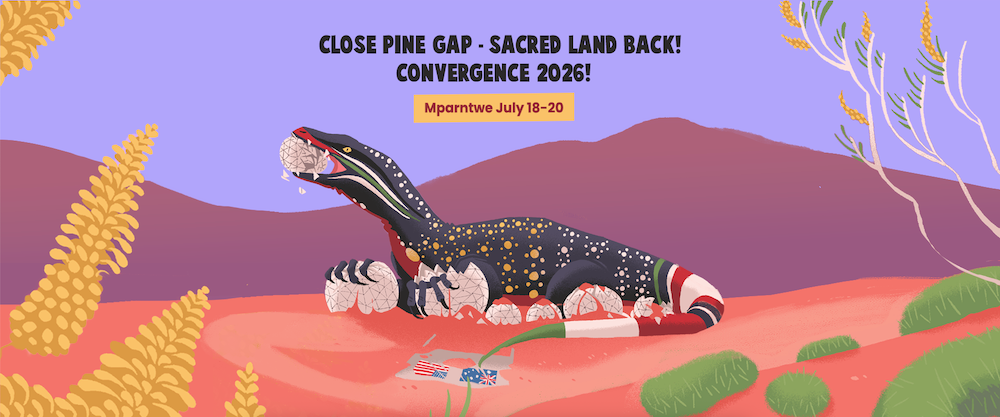
Pine Gap Convergence 2026: "Arrernte Custodians and local residents of Mparntwe/Alice Springs invite you to come and participate in three days of workshops, discussion, connecting and peaceful protest in July 2026." ↩︎
Member discussion